


Before Virginia Had a Name: Life in the Paleoindian WorldVirginia During the Paleoindian Period, c. 13,000–8000 B.C.

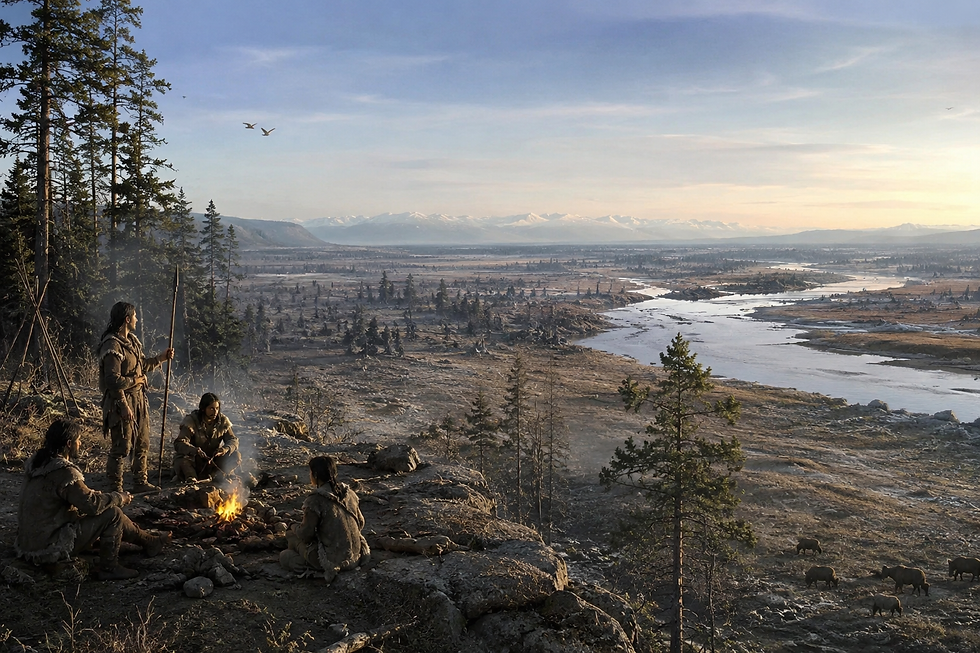
Imagine standing in Virginia more than 13,000 years ago.
The morning air is cold. Mist hangs above a river valley as the first light appears beyond the trees. There are no roads beneath your feet, no farms stretching toward the horizon, and no towns marked on maps.
There is not even a place called Virginia.
But there are people.

Near the river, a small group gathers around the remains of a fire. One person carefully examines a stone point. Another prepares for the day's journey. A child watches an older relative strike one piece of stone against another, sending a thin flake falling to the ground.
Every strike is deliberate.
Every tool matters.
Every lesson could help another generation survive.
Welcome to the Paleoindian period, one of the earliest well-documented chapters of human life in the region we now call Virginia.
A Virginia Very Different From Today
Travel back to approximately 13,000 B.C., and the landscape would not look exactly like the Virginia we know.
The last Ice Age was ending. Virginia itself was not buried beneath the enormous continental ice sheets that covered lands farther north, but the region experienced a cooler climate and different ecological conditions.
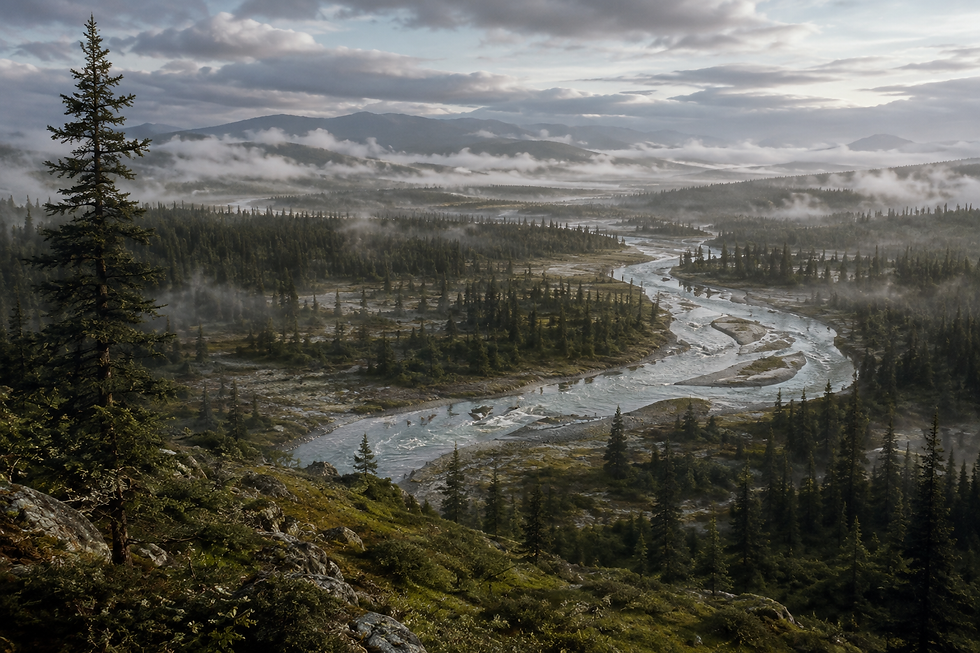
Sea levels were much lower because enormous amounts of the world's water remained locked in glacial ice.
The modern Chesapeake Bay did not yet exist in its present form.
Instead, rivers crossed landscapes that would eventually be flooded as glaciers melted and sea levels rose. Some ancient places once visited by people are therefore underwater today.
Imagine a family standing beside one of those ancient waterways.
They cannot know that thousands of years later the landscape will change dramatically.
For them, this is simply home.
Following the Land
Paleoindian communities were highly mobile.
But calling them mobile does not mean they wandered without direction.
Quite the opposite.
Movement required knowledge.
Where was fresh water?
Where could useful stone be found?
Where were animals likely to travel?
Which plants could be gathered?
Where was shelter available when the weather changed?
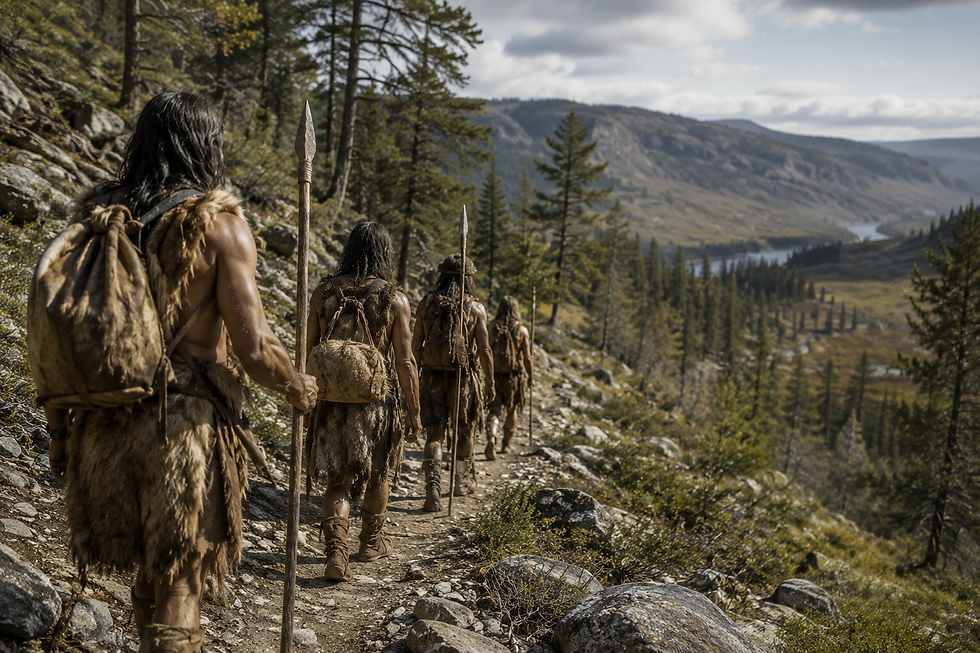
People learned to read the landscape.
Imagine several families preparing to leave a campsite.
The fire is extinguished. Tools are gathered. Food and other necessary materials are packed.
They cannot carry everything.
What they take must be useful.
A well-made stone tool is valuable. So are objects made from wood, bone, animal hide, plant fibers, and other materials.
Most of those organic objects have disappeared over thousands of years.
Stone survives.
That is one reason stone tools provide archaeologists with some of our most important evidence of Paleoindian life.
A Stone Point and a Human Hand
Sit beside our imagined Paleoindian family again.
An experienced stoneworker holds a piece of stone.
A younger person watches.
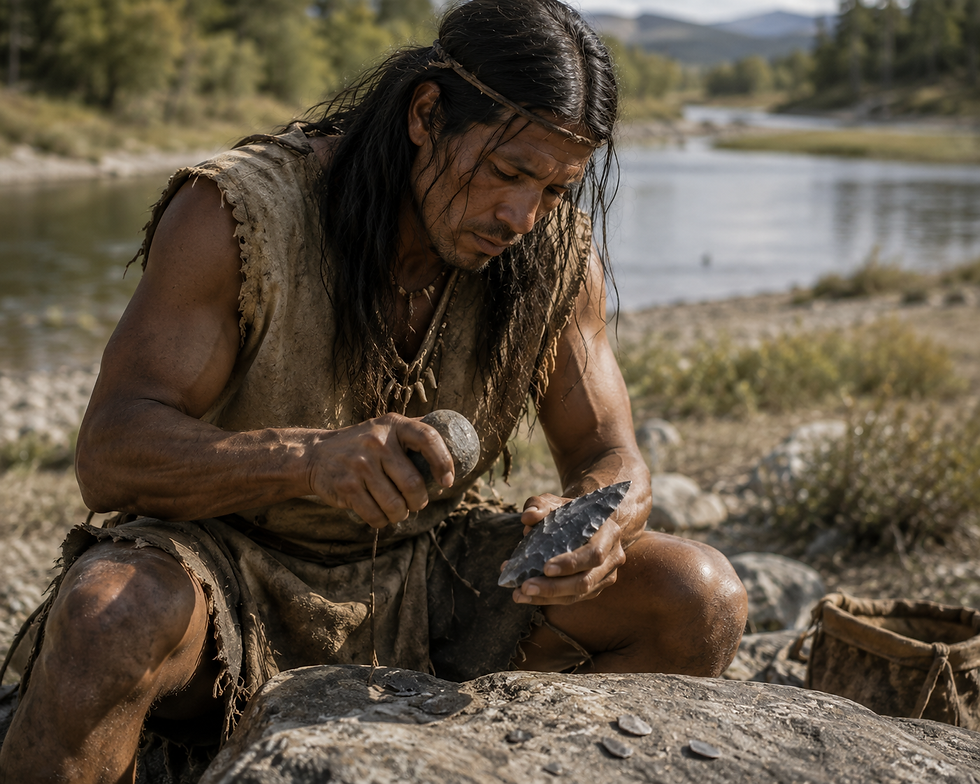
The stoneworker strikes it.
Tap.
A flake falls away.
The stone is turned.
Another careful strike.
Tap.
Gradually, an object emerges.
Among the best-known artifacts associated with Paleoindian archaeology are fluted projectile points, including the distinctive type archaeologists call Clovis points.
Creating such a point required skill.
The maker needed to understand the properties of the stone and know how force would travel through it. One incorrect strike could damage hours of work.
Now imagine the younger person attempting the technique.
Perhaps the first attempt fails.
The elder demonstrates again.
Try here.
Turn the stone.
Strike differently.
Watch.
The knowledge passes forward.
Thousands of years later, an archaeologist may discover the finished point.
We see an artifact.
But behind that artifact was once a teacher, a learner, a family, and a moment in someone's life.
Were They Mammoth Hunters?
Popular images of Paleoindian people often show hunters pursuing mammoths and other Ice Age animals.
Large mammals certainly lived in North America during portions of this period, and hunting was an important part of Paleoindian life.
But their lives should not be reduced to a single image of people chasing megafauna.
Survival required flexibility.
People likely hunted different animals when opportunities arose while also making use of plant foods and other resources available within their environments.
They needed water.
They needed fuel for fires.
They needed materials for tools.
They needed shelter.
And they needed one another.
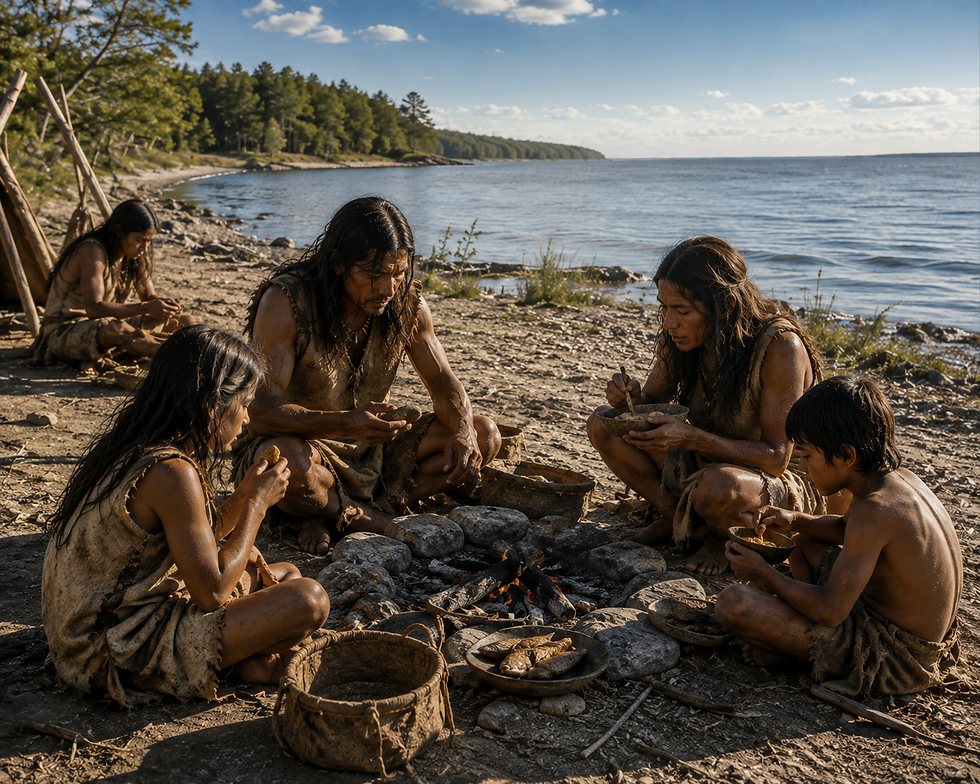
A successful community depended upon cooperation.
Someone had to recognize the best stone.
Someone had to know the landscape.
Someone had to understand animal behavior.
Someone had to care for children.
Someone had to preserve the knowledge of previous generations.
Daily life was a collection of skills working together.
Virginia's Ancient Stone Sources
Certain places in Virginia were especially valuable because they contained high-quality stone suitable for tools.
One important archaeological area is Flint Run in the Shenandoah Valley, where Paleoindian sites have provided evidence associated with quarrying and working jasper.
Imagine traveling toward such a place.
Perhaps the route has been traveled before.
The people know where they are going.
When they arrive, stone is selected carefully. Some pieces may be worked near the source. Other material can be carried away for later use.
Archaeologists can sometimes trace stone artifacts to particular geological sources.
That raises intriguing possibilities.
If an artifact is found far from the place where its stone originated, how did it get there?
Did one person carry it?
Did a family travel that distance?
Was the material exchanged between different groups?
Stone becomes evidence not merely of technology but of movement and connection.
Growing Up in Paleoindian Virginia
Now imagine the world through the eyes of a child.
There are no books.
No written instructions.
No classroom.
And yet education happens every day.
Watch how the tool is made.
Learn where the river becomes dangerous.
Remember where animals cross.
Know which materials burn best.
Listen when older people speak.
Follow the people who understand the route.
A child's survival depended upon learning.
We cannot know the stories Paleoindian parents told their children or what spiritual beliefs they held. Archaeology cannot recover every part of a person's life.
That limitation is important.
We also do not know what these ancient people called themselves.
Names of historically documented Virginia Native nations should not automatically be projected thousands of years backward onto Paleoindian communities without evidence.
The people themselves, however, were real.
They had relationships.
They experienced hunger and satisfaction, cold and warmth, danger and security.
They taught.
They learned.
They remembered.
When the World Began to Change
Generations passed.
The climate continued warming.
Forests changed.
Animal populations changed.
Sea levels rose.
River systems and coastlines were transformed.
Some of the large Ice Age mammals disappeared.
But people remained.
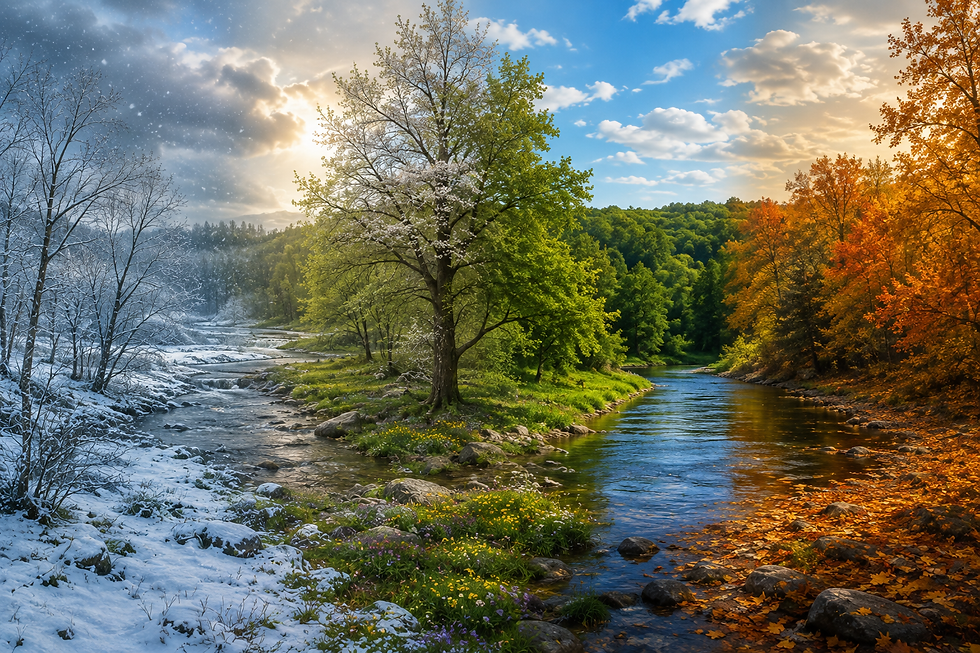
They adapted their strategies to new environments and increasingly diverse resources.
By approximately 8000 B.C., archaeologists recognize changes significant enough to mark the transition toward what is called the Archaic period.
But no Paleoindian family woke one morning and announced that their period of history had ended.
These archaeological periods are modern tools for understanding gradual changes that took place across enormous spans of time.
For the people themselves, life continued.
Parents taught children.
Children became adults.
Knowledge was modified and passed forward.
Before Virginia Had a Name
Stand beside a Virginia river today and look across the water.
Now remove the bridges.
Remove the roads.
Remove the houses.
Remove the names printed on the map.
Imagine a person standing there thousands of years ago.
Perhaps that person carries a stone point.
Perhaps a child walks nearby.
Perhaps they are watching the river, deciding whether to remain another day or continue their journey.
We will probably never know their names.
But we know they were here.
The Paleoindian period reminds us that Virginia's human story reaches far beyond written history and European colonization.

Long before Jamestown was founded in 1607, generations of Native people had already lived within these landscapes.
They traveled Virginia's waterways and valleys.
They gathered food.
They hunted.
They made tools.
They taught their children.
They adapted to extraordinary environmental change.
And they left traces of their lives beneath the soil.
A stone point may appear to be a small object.
But look more closely.
Behind it is a human hand.
Behind that hand is a person.
Behind that person is a family.
And behind that family is the beginning of a story stretching across more than 13,000 years of Native history in Virginia.
Before there was a Virginia, there were people.
About the Author

Dr. Guadalupe Vanderhorst Rodriguez, D.Ac., L.Ac. is an author, genealogist, historian, and educator with more than 40 years of genealogical research experience. Her research was featured on the television series Who Do You Think You Are?, and she is the author of several genealogy and family-history books.
Dr. Rodriguez is the founder of the Tan American Historical Association, Kicotan Wellness, and Kicotan Haven, and is one of the founders of the Kikotan Nation. Her work is dedicated to researching and preserving family histories, Indigenous heritage, and ancestral stories so they can be passed forward to future generations.
Her guiding philosophy is simple: Remember the Past. Care for the Present. Prepare for the Future.
Comments