


Following the Moon: How Native Peoples Used the Moon to Understand the Seasons

Looking to the Sky to Understand the Earth
Long before calendars hung on walls or dates appeared on phones, Indigenous peoples throughout North America observed the natural world to understand the passage of time.
The rising and setting of the sun, the changing seasons, the movement of animals, the flowering of plants, and the changing appearance of the moon all provided information.
The moon was especially important because its repeating cycle offered a visible way of recognizing the passage of time.

For many Native peoples, observing the moon was not simply about counting days. It was part of understanding our relationship with the natural world.
The moon could help mark seasonal changes, planting and harvesting periods, ceremonies, gathering times, hunting and fishing seasons, and other activities important to community life.
However, there was never one universal “Native American moon calendar.” Indigenous Nations developed their own traditions according to their homelands, languages, environments, and teachings.
That distinction is important.
The moon teachings of a Haudenosaunee community, for example, should not automatically be assumed to be the same as those of an Ojibwe, Lakota, Cherokee, Powhatan, or another Native community.
For the Kikotan Nation, learning about Indigenous relationships with the moon gives us an opportunity not only to study the past but also to become better observers of the land, water, seasons, and sky around us.
Understanding the Phases of the Moon
The moon moves through a repeating cycle approximately every 29.5 days. During that cycle, the portion of the moon illuminated by the sun appears to change when viewed from Earth.
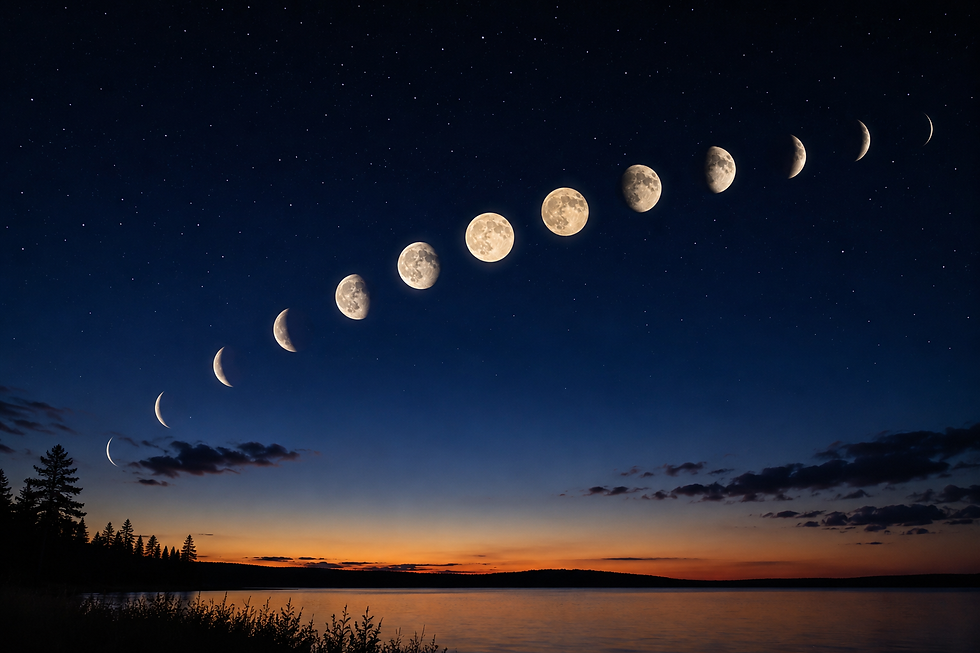
There are eight commonly recognized phases:
1. New Moon
During the New Moon, the moon is positioned so that the illuminated side is mostly turned away from Earth. The moon may appear invisible or very difficult to see.
It marks the beginning of a new lunar cycle.
2. Waxing Crescent
A thin crescent of light begins to appear.
“Waxing” means that the illuminated portion visible from Earth is increasing.
3. First Quarter
Approximately half of the moon's visible surface appears illuminated.
The moon is about one-quarter of the way through its orbit around Earth, which is why this phase is called the First Quarter.
4. Waxing Gibbous
More than half of the moon appears illuminated, but it has not yet reached the Full Moon.
Each night, the illuminated portion continues to increase.
5. Full Moon
The moon appears as a complete illuminated circle.
The Full Moon has often been an especially recognizable point in the lunar cycle and could serve as an important seasonal marker.
6. Waning Gibbous
Following the Full Moon, the illuminated portion begins to decrease.
“Waning” means becoming smaller.
7. Last Quarter
Once again, approximately half of the moon appears illuminated, but now the lunar cycle is moving toward another New Moon.
8. Waning Crescent
Only a thin crescent remains visible.
Eventually, the moon returns to the New Moon, and another cycle begins.
The pattern repeats throughout the year.
The Moon as a Way of Keeping Time
For some Indigenous peoples, a lunar cycle represented a natural way of measuring time.
The Oneida Nation, for example, teaches that each moon cycle begins with the New Moon and continues until the next New Moon. Approximately 13 lunar cycles occur during a solar year.
Oneida educational materials also describe the turtle shell as a teaching tool connected with lunar cycles: the shell's pattern is associated with 13 larger sections and 28 smaller sections around its exterior.
The moon therefore becomes more than something beautiful in the night sky. It becomes part of a larger system of observing relationships and cycles.
Rather than separating people from nature, this understanding places human beings within those cycles.
Why Do Full Moons Have Names?
Many people today are familiar with names such as Strawberry Moon, Harvest Moon, Hunter's Moon, Snow Moon, or Sturgeon Moon.
It is tempting to describe these collectively as “the Native American names for the Full Moons.”
That is an oversimplification.
Different Indigenous Nations had—and continue to have—their own languages, calendars, seasonal observations, and names for lunar periods.
A moon name often reflected what was happening in a particular homeland at that time.
A name might refer to:
the ripening of a particular fruit;
the movement or availability of an animal or fish;
snow, cold, or changing weather;
planting or harvesting;
the appearance of particular plants;
or an important seasonal activity or ceremony.
This tells us something important about Indigenous knowledge.
The calendar was connected to place.
The people watched what was happening around them.
Familiar Moon Names
Today, several seasonal moon names are widely encountered in books, calendars, and popular culture.

Among them are:
Wolf Moon — January -Often associated today with the deep winter period.
Snow Moon — February -Associated with the snowy conditions of winter in parts of North America.
Worm Moon — March -Often associated in modern calendars with the seasonal transition toward spring.
Pink Moon — April-Associated with spring flowering plants rather than the moon actually becoming pink.
Flower Moon — May-Associated with the abundance of flowers and plant growth during spring.
Strawberry Moon — June-A name associated in some Indigenous traditions with the season when strawberries become available.
Buck Moon — July-Associated with the period when new antler growth is visible on male deer.
Sturgeon Moon — August- Associated with sturgeon and seasonal fishing traditions in some Great Lakes communities.
Harvest Moon — September- Associated with the harvest season. Astronomically, the Harvest Moon is the Full Moon occurring closest to the autumnal equinox, so it does not always occur in September.
Hunter's Moon — October-Traditionally associated in some communities with the hunting season following the harvest.
Beaver Moon — November- A name historically associated with seasonal observations and activities involving beavers.
Cold Moon — December- Associated with the arrival of colder weather and long winter nights.
These names can be useful for introducing people to seasonal awareness, but they should not be presented as one universal Native American system.
Indigenous Moon Names Tell Us About the Land
Perhaps the most important lesson is not memorizing twelve Full Moon names.
The deeper lesson is learning why people named periods of the year according to what they observed.
Imagine living without a printed calendar.
How would you know that one season was becoming another?

You would watch.
You might notice when particular fish returned to local waters.
You would recognize when certain berries ripened.
You would notice when deer behaved differently.
You would know when certain plants appeared.
You would observe changes in temperature, rainfall, daylight, tides, and the night sky.
Over generations, these observations became knowledge.
That knowledge could then be passed from grandparents to parents, from parents to children, and from one generation to another.
The Moon and Ceremony
The moon also holds ceremonial importance among some Native Nations.
For example, the Oneida Nation explains that ceremonial timing involves careful observation of agriculture, the moon, and seasonal cycles. The Nation's teachings describe the Moon Dance as a thanksgiving honoring Grandmother Moon.
These teachings demonstrate something deeper than astronomical observation.
The moon is understood within a network of relationships involving people, plants, waters, seasons, the Earth, and the spiritual world.
The details of those relationships vary from Nation to Nation.
What Might the Moon Teach the Kikotan Nation Today?
For the Kikotan Nation, learning about lunar traditions gives us an opportunity to ask an important question:
What did our ancestors see when they looked toward the night sky from the lands and waterways of Tidewater Virginia?
They lived in a world shaped by water, forests, wetlands, fish, shellfish, wildlife, plants, changing seasons, and the Chesapeake Bay.
The moon they observed is the same moon we can observe today.
We should be careful not to invent traditional Kikotan moon names where historical documentation has not yet established them. Instead, we can research the surviving historical record, learn respectfully from documented traditions of other Native Nations, and begin observing the seasonal cycles of the Kikotan homeland ourselves.
When do particular birds return?
When do native plants flower?
When do fish move through the waterways?
When do berries ripen?
How does the shoreline change?
What happens to the tides?
What changes can we observe from one moon to the next?
These questions transform the moon from an object we occasionally notice into part of an ongoing relationship with place.
The Moon and the Seven Generations
Following the moon also connects naturally with the principle of thinking about the generations that came before us and those who will come after us.
Our ancestors observed the natural world because their lives depended upon understanding relationships.
They learned through observation.
They remembered.
They taught their children.
Their children carried knowledge forward.
We can continue that responsibility.
Imagine a Kikotan child standing beside the Chesapeake generations from now and being able to recognize the moon, the tides, the plants, the birds, and the changing seasons because someone took the time to teach them.
That is how knowledge survives.
Look Up and Begin Again
Tonight, look at the moon.
Do not simply ask, “What phase is it?”
Ask:
What is happening on the Earth beneath this moon?
Notice the temperature.
Notice the trees.
Notice the water.
Listen for the birds and insects.
Watch what is flowering, growing, ripening, migrating, or becoming dormant.
Then observe again during the next moon.
Our ancestors learned by watching the world around them. We can begin doing the same.
The moon reminds us that life moves in cycles—beginning, growing, reaching fullness, releasing, resting, and beginning again.
And as we remember the generations behind us, care for the world around us today, and prepare knowledge for those who will follow, we continue an ancient responsibility:
Remember the Past. Care for the Present. Prepare for the Future.
For the Seventh Generation — Kikotan Nation
Dr. Guadalupe Vanderhorst Rodriguez, intentionally separated the eight astronomical phases from the seasonal moon names. Oneida Nation materials support the broader point particularly well: Oneida describes lunar cycles as beginning at the New Moon, connects the lunar calendar with turtle-shell teachings, and explains that ceremonial timing can involve observation of the moon, agriculture, and seasons. Oneida also documents a Moon Dance honoring Grandmother Moon.
This approach will allow Kikotan Nation to educate readers about Indigenous lunar knowledge without implying that modern lists of “Native American Full Moon names” were historically used by the Kikotan people when that has not been established.
About the Author

Dr. Guadalupe Vanderhorst Rodriguez, D.Ac., L.Ac. is an author, genealogist, historian, and educator with more than 40 years of genealogical research experience.
Her genealogical research was featured on the television program Who Do You Think You Are?, highlighting her dedication to uncovering and preserving family history.
As a direct descendant of the Tann family and a historian of the Kikotan Nation, Dr. Rodriguez is committed to preserving Indigenous history, ancestral stories, and family legacies for future generations.
Her work reflects the principle of Seven Generations—remembering the past, caring for the present, and preparing for the future.


Comments